Blog
← Older posts Newer posts →The Counsel of Desirable Outcomes: Actions versus Achievements
The bane of most, perhaps all, how-to books in management and business is what I call the “Counsel of Desirable Outcomes” – advice that sounds like action but really consists of achievements. Take a recent article in the Financial Times entitled “Five steps to sustainable productivity growth”. Written by two management consultants from PwC, it defines “five concrete steps you can take to create policies that will drive your productivity growth”. The five steps are:
- Determine how good you are at sustaining productivity growth
- Specify productivity improvement in innovation and growth plans
- Simulate productivity growth scenarios and their impact on objectives and measures
- Create a shared company business design with an operational path to short, medium, and long-term productivity growth
- Align on a more comprehensive, simplified set of productivity measures
What can one say about this advice? On the surface it’s difficult to quarrel with it: Is it clear? Well it seems to be clear. The root metaphor is that of taking steps along a path. If the creation of sustainable productivity in an organization is like that, then it’s a promising start. Is it actionable? Well every step starts with a verb and verbs have to do with action…But wait! On closer inspection each verb is really an achievement rather than an action – it says “create this desirable outcome”. What we are looking at is outputs of many different, complex processes designed to look like inputs to a single, linear process.
Posted in Change, General | Tagged achievement verbs, action verbs, ecological perspective, Gilbert Ryle, inputs, outputs, productivity growth, PwC, RONA | 1 CommentT-shaped People: Deduction, Induction, Abduction and Systems Thinking

Visualizing T-shaped Thinking
IDEO, the design and innovation firm, prizes what they call “T-shaped” individuals. These are people with a deep expertise in one field or domain (the vertical stroke of the “T”) and some expertise across several, often dissimilar, domains (the horizontal stroke of the “T”). IDEO finds that this combination leads to particularly creative innovations because such individuals can see patterns and explore insights from many different perspectives. What are the thinking processes involved in T-shaped thinking? I like to think that there are three major ones. The names of the first two modes – deduction and induction – are well known. The name of the third process – abduction – is hardly known at all, but it is critical to the whole creative process. In this blog I discuss all three modes of thought and their connection to systems thinking.
Deduction and Induction
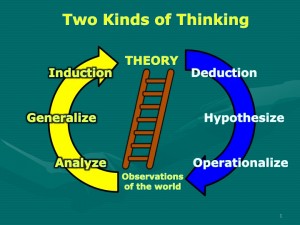
The Ladder of Abstraction – Deduction and Induction
These two modes of thought are by far the best known. I visualize them running down (deduction) and up (induction) the vertical stroke of the “T”, which is actually a ladder of abstraction. At the top of the T are coarse-grained concepts; at the bottom are events in the real world, or at least our perception of them. Deduction starts at the top and heads downward – it is “top-down logic” – it begins with premises and ends up with conclusions. If the premises are true and the logic is correct, then the conclusions must be true. Induction works in the opposite direction; it is “bottom-up logic”. It begins with specific examples and then attempts to draw general conclusions from them. Whereas deduction works with certainty – it’s either right or wrong – induction is concerned with establishing probabilities.
Posted in Change, General, Leadership, Strategy | Tagged abduction, analogical, analytical, bottom-up, Charles Sanders Peirce, complex systems, creativity, deduction, ecological perspective, IDEO, induction, innovation, leveraged action, systems, T-shaped, thinking, top-down | Comments Off on T-shaped People: Deduction, Induction, Abduction and Systems ThinkingIs Conscious Capitalism A Conceptual Mess?
Conscious Capitalism (CC) is featured prominently in the latest issue of the California Management Review (CMR) (Spring 2013, Vol. 55 No. 3.). In an article entitled “Conscious Capitalism Firms: Do They Behave as Their Proponents Say?”, Chong Wang, an Assistant Professor at the Naval Postgraduate School in Monterey, California challenges the “scientific status” of the theory of conscious capitalism. Using a sample of 17 CC firms he compared their results with a matched set of non-CC equivalents against several distinguishing criteria developed by the proponents of CC.
Professor Wang tested four assertions. These were that, compared with non-CC firms, CC firms have:
- Lower gross margins (gross profit as a percentage of sales)
- Higher profit margins (net income as a percentage of sales)
- Lower selling, general and administrative (SG&A) as a percentage of sales
- Lower marketing costs (advertising expenses as a percentage of sales)
In his findings he rejected #1 – CC firms have higher gross margins than their non-CC rivals, a finding that should not surprise anyone who has ever shopped at Whole Foods! He found support for #2 – CC firms have fatter bottom lines. He could find no evidence to support assertions #3 and #4. He developed an analysis that suggested that CC firms were no less attentive to the stock markets than non-CC firms; they managed their earnings just like their non-CC rivals. In short, Professor Wang questioned the entire conscious capitalism narrative, including how firms were selected as being members of the group.
Posted in Change, General, Leadership, Strategy | Tagged Anglo-Saxon capitalism, Aristotle, Chong Wang, complex systems, conscious capitalism, ecological perspective, innovation, Karl Popper, Max Weber, narrative, Raj Sisodia, The New Ecology of Leadership, Whole Foods | 1 CommentComplexity and the Plexus Institute: The Critical Role of Intuition in Action and Thought

The Plexus Institute Logo
Last Friday I took part in an online discussion of The New Ecology of Leadership arranged by The Plexus Institute. The institute describes itself as “an intertwined community of diverse people–scientists, business executives, nurses, artists, teachers, journalists, researchers, physicians, college students, community leaders, and thinkers–united in our determination to create something better. By learning from and with each other, we are making strides against some of the major problems afflicting society and human organizations.” A “plexus” is defined as: 1. Anatomy and zoology: A structure consisting of a bundle of minute closely interwoven and intercommunicating fibers or tubes; a network of nerve fibers or blood vessels. 2. General: Any intertwined or interwoven mass; an intricate arrangement or collection of things; a web, a network.
I joined Plexus last year and they do a wonderful job of keeping one in touch with many aspects of complexity and complexity thinking. The weekly PlexusCalls feature a wide variety of different perspectives. Many of the institute’s members are from the healthcare system and the definition of a plexus seems to describe them admirably! My partner in the discussion was Dr. Felix Ankel, Director of Emergency Medicine Residency at Regions Hospital, St. Paul, Minnesota and Associate Professor of Emergency Medicine at the University of Minnesota. I prepared a slide presentation of about 30 minutes in length and the entire one-hour long call was recorded (you can download the mp3 here)
Posted in General | Tagged Dan Sperber, ecological rationality, Felix Ankel, Ger Gigerenzer, Hugo Mercier, intuition, Jonathan Haidt, paradigm, plexus, Plexus Institute, principles, rationalist illusion, The New Ecology of Leadership, wicked problems | Comments Off on Complexity and the Plexus Institute: The Critical Role of Intuition in Action and ThoughtChanging Behaviour Without Changing Minds: the case of the Stockholm congestion charge

Stockholm City map showing charge points
Pioneering management writer, Mary Parker Follett (1868-1933), was one of the first to make the argument that in practices like management we act our way into better ways of thinking rather more easily than the other way around. In 1924 she wrote; “The theory of consent rests on the wholly intellectualist fallacy that thought and action can be separated…on the assumption that we think with our ‘minds’ and we don’t…how often we see cases where we have not been able to persuade people, by our most careful reasoning, to think differently, but later, by giving them the opportunity to enter onto a certain course of action, their ‘minds’ are thereby changed.” (Creative Experience)
I remembered her words when I read about the successful implementation of a traffic congestion charge in Stockholm, Sweden. The idea had been mooted since the early 1990s but without public or political support. After the 2002 elections the Left and Green parties forced the minority Social Democrats to introduce congestion ‘taxing’ (it’s called a tax because in Sweden it is a parliamentary, not a municipal issue) even though there was little public support for it (70% against) and the major newspapers were solidly opposed. Politically it was regarded as “the most expensive and painful way to commit political suicide ever devised”. Nevertheless, buoyed by the initial success of the controversial London congestion charge (introduced in 2003), it was agreed that the full-scale experiment would run for seven months from January 2006. Then a referendum would be held.
Posted in Change | Tagged analyze-think-change, change, congestion charge, ecological perspective, ecological rationality, Jerry Sternin, John Kotter, Jonas Eliasson, London, Mary Parker Follett, Nudge, positive deviance, see-feel-change, Stockholm | 1 CommentLessons from Another Wildfire Tragedy: Nature Bats Last

Yarnell Hill fire Arizona 2013
The tragic death over the weekend of nineteen firefighters fighting a fierce wildfire in defence of the town of Yarnell, Arizona is a reminder of the perils of building structures on top of processes. This week’s blog is based on an excerpt from The New Ecology of Leadership that draws an analogy between organizations and settlements on the edge of the fire-dependent forests of Western North America. It argues that established organizations are just like houses built on the edge of the Western wilderness or on a coastal barrier islands. They are apparently stable, successful structures surrounded by multiple processes of change – changes in their components and in their contexts. Some of these processes are visible; many are not. This is because of the vast range of scales on which the changing elements operate. We can learn a great deal about the origins and dynamics of crisis from nature.
Crisis in Nature
For sheer spectacle and drama little beats a wilderness wildfire. It must be network television’s favorite natural catastrophe. Thus, in October 2007, when wildfires burned in the idyllic suburbs of San Diego County, our television screens were full of images of smoke and flame for nearly three weeks. Dry Santa Ana winds swept down the mountains from the north- east at speeds of up to 100 mph, driving a firestorm with horizontal flames more than 200 feet long. Spectacular fire tornados spiraled hundreds of feet into the air, deploying an advance guard of glowing embers that could kindle the tinder-dry brush hundreds of yards ahead of the main front. Burning houses were the hottest objects, capable of igniting their neighbors through radiant heat alone. Television anchors told stories of heroic firefighters and showed pictures of the exhausted men against the back- ground of the infernos.
Posted in Change, General | Tagged Arizona, change, chaparral, community, lodgepole pine, process, San Diego, Santa Ana, structure, wildfire, Yarnell | 1 CommentWhy Strategy Has Lost Its Mojo
This post appeared last Friday on the Strategic Management Bureau site as a “Strategic Snack“. You can follow the discussion on LinkedIn here
The Urban Dictionary gives three definitions for mojo:
- Self-confidence, self assuredness (especially in sexual advances or battle)
- Good luck fetish or charm to bolster confidence
- Ability to bounce back from a debilitating trauma
Last week (June 13) the Strategy Snack featured Harvard Business School’s Cynthia Montgomery suggestion that “we” have “backed strategy into a corner” and it needs to be “rebranded”, so that it can be seen as the “animating force of the organization”, “the energy that directs everything the organization does”. She talked about “the” leader as chief strategist making “very deliberate choices” about “what a business is and why it matters”. It was pretty clear that strategy has lost its mojo.
Posted in Change, Leadership, Strategy | Tagged change, Cynthia Montgomery, ecological perspective, Kenneth Andrews, leadership, logical empiricist, Michael Porter, narrative, rational choice, Richard Pascale, strategy | 2 CommentsOur Curious Addiction to Corporate Grand Strategy

Richard T. Pascale
This week my blog is devoted to republishing (with his permission) Richard T. Pascale’s column from the January 25, 1982 edition of Fortune magazine. It’s an oldie but goodie not available elsewhere online. Much has changed since he wrote the piece but it still makes for good reading and is relevant to the current debate about the role and status of strategy as a management concept.
Our Curious Addiction to Corporate Grand Strategy by Richard T. Pascale
Fortune’s recent four-part series, “New Management Strategies,” traced the dominant strategic concepts of the Seventies, such as the experience curve and portfolio theory, and outlined a new generation of ideas that seemed destined to satisfy the insatiable American appetite for such material. But why do we, as compared with the Japanese, for example, make such a fuss about strategy in the first place? Why was an entire decade’s worth of managers swept away by concepts that in the final analysis have been found quite misleading? Why do we stand ready to accept the “new wave” concepts of the Eighties with undiminished enthusiasm?
Our strategy fetish is a cultural peculiarity. We get off on strategy like the French get off on good food or romance. The very term stirs something within us. It evokes images of Napoleon or MacArthur masterfully turning the tide of battle with a bold vision. There is something masculine about it too – and high status. It seems fitting that corporate leadership concern itself with strategy. Not surprisingly, the $300-million-a-year management-consulting industry has latched onto “strategic concepts” as the best potion for arousing corporate chieftains since firewater.
Posted in Change, Leadership, Strategy | Tagged Abernathy, Bruce Henderson, change, experience curve, Fortune, Harley-Davidson, Hayes, Honda, Japan, Mazda, McKinsey, piano, portfolio theory, Richard Pascale, strategy, Talon, Timex, Toyopet, Yamaha, YKK | 1 CommentPrinciples and Paradigms: The Debate Continues

Mary Parker Follett (1868-1933)
Steve Denning, with whom I have jousted in the columns of Forbes, about the nature of management paradigms, recent wrote a blog in HBR in the series leading up to the fifth annual Global Peter Drucker Forum on November 2013 in Vienna. In it he made the familiar claim that successful companies, like Apple and Salesforce, have rethought the “rules” of management and have applied new heuristics to produce these desirable outcomes. You can read his blog here. This gave me the opportunity to respond to him and outline more precisely why I find this line of argument rather unsatisfactory:
“Every time I read about new management principles replacing old, outdated ones I remember Mary Parker Follett’s cautionary comment:
‘The difficulty with all revolutions is this: the leaders think that they can substitute new ideas for old before they have changed the action tendencies, habit systems of people. As this cannot be done, revolution after revolution fails. The first thing that a normal class of revolutionists should be taught is that behaviour must be changed through experience, that it cannot be changed through the impact of ideas.’ (Creative Experience, 1924)
Posted in Change, Leadership, Strategy | Tagged Anna Karenina, change, community, complex systems, context, discipline, ecological perspective, embodied cognition, equifinality, Fighting Power, freedom, heuristic, implementation, Ludwig von Bertalanffy, Mary Parker Follett, obligations, paradigm, Peter Drucker, practical wisdom, principle, rights, self-discipline, Steve Denning, systems, Tolstoy, van Creveld | 1 CommentDecommoditize Yourself! – Coating Products in Meaning
Last week I travelled to Phoenix, Arizona to attend the annual meeting of Electro-Federation Canada and to deliver the opening keynote address. The association works with the electrical, consumer electronics and telecommunications industries and its membership consists of manufacturers and their agents and distributors throughout Canada. The issues that they face are common to many such groups – relentless change and the progressive commoditization of their products and services as a result of globalization and technological advances.
I set out to give them a different perspective on their industry, looking at it as an ecosystem and at the firms within it as ecological processes, rather than just as economic structures. After doing that, I gave an ecological approach to answering the questions, “So what?” and “Now what?”.
Posted in Change, General, Leadership, Strategy | Tagged A.G. Lafely, Anglo-Saxon capitalism, change, commoditization, community, context, cult, David Brooks, Dom Perignon, ecological perspective, ecosystem, Electro-Federation Canada, Ferrari, identity, meaning, narrative, niche, P&G, product life cycle | 1 Comment ← Older posts Newer posts →Subscribe to David's Blog
-
Archives
- July 2026
- May 2026
- October 2025
- January 2025
- November 2024
- May 2024
- February 2023
- December 2022
- September 2022
- May 2022
- March 2022
- February 2022
- November 2021
- October 2021
- January 2021
- November 2020
- September 2020
- July 2020
- June 2020
- May 2020
- April 2020
- February 2020
- January 2020
- September 2019
- July 2019
- April 2019
- March 2019
- November 2018
- October 2018
- March 2018
- July 2017
- April 2017
- November 2016
- October 2016
- June 2016
- May 2016
- April 2016
- March 2016
- December 2015
- November 2015
- October 2015
- May 2015
- March 2015
- January 2015
- December 2014
- November 2014
- September 2014
- July 2014
- June 2014
- May 2014
- April 2014
- March 2014
- February 2014
- January 2014
- December 2013
- November 2013
- October 2013
- September 2013
- August 2013
- July 2013
- June 2013
- May 2013
- April 2013
- March 2013
- February 2013
- January 2013
- December 2012
- November 2012
- October 2012
- September 2012
- August 2012
- July 2012
- June 2012
- May 2012
- April 2012
- March 2012
- February 2012
-
Meta

David Hurst in Action

Consulting