Blog
← Older posts Newer posts →Don’t Throw the Past Away: Rediscovering the “Drucker Space”

History
For Peter Drucker history was an essential resource. Commentators have described the scope of his writings as “Braudelian” in honor of the work of historian, Fernand Braudel, the leader of the French Annales school of history, renowned for its broad, integrative approach. Drucker’s illustrations of organization and change included both the British Raj in India and the Meiji Restoration in Japan. A trio of little-known German thinkers, Willem von Humboldt (1767-1835), Joseph von Radowitz (1797-1853) and Friedrich Julius Stahl (1802-1861) informed his understanding of what it took to preserve the traditions of the past while facilitating rapid change.
Posted in Change, General | Tagged American Dream, Boorstin, change, Drucker Forum, Drucker Space, efficiency, European Enlightenment, Frederick Taylor, Leon Wieseltier, meaning, means and ends, narrative, Peter Drucker, Postman, Progress, purpose, Radowitz, Stahl, Technopoly, The New Republic, Wilhelm von Humboldt | Comments Off on Don’t Throw the Past Away: Rediscovering the “Drucker Space”Management by Machine: MBO as Manipulation?
Recently Adrian Wooldridge, the Schumpeter columnist for The Economist, reviewed the introduction by BetterWorks, a Silicon Valley startup, of “goal science” to the workplace. The New York Times reviewed the same company on Monday. The company “makes office software that blends aspects of social media, fitness tracking and video games into a system meant to keep employees more engaged with their work and one another. With the software, employees and their bosses set long- and short-term goals, and, over time, log their progress on a digital dashboard that everyone in their company can see and comment on.” The idea is to make the Management by Objectives (MBO) process more frequent and more “data-driven”. One wonders whether this is the real challenge with MBO. More often the problem is with the philosophy behind the technique, rather than with the technique itself.
MBO; an Elusive Philosophy
Management by Objectives (MBO) is a deceptively simple technique that is very difficult to employ effectively. The philosophical framework within which it is used is critical. Given Peter Drucker’s background, upbringing and his emphasis on self-discipline, it seems likely that his original intent was that MBO should be the civilian equivalent of the system of mission command or auftragstaktik, developed by the Prussian army in the 19th Century. The essence of this system was that no commander should issue an order that went beyond what he could know of the actual situation. Rather he should declare an intent that created a space within which his subordinates would have the freedom to act as they saw fit. They, in their turn, would declare their slightly narrower intents and so on, down the line. This cascading set of “action spaces” preserved autonomy and creativity at every level of the organization. Helmuth von Motlke the Elder (1800-1891), who perfected the system, made no distinction between strategy development and execution – strategy could emerge bottom-up through “directed opportunism”, just as readily as it could be formulated top-down. Mission command is still the gold standard for armed forces all over the world. But, outside of small Special Forces units, it has proved extremely difficult to implement – the words are easy, but behavior and the selection and training required to produce and sustain it are difficult. Continue reading →
Posted in Change, General, Leadership, Strategy | Tagged Adrian Wooldridge, auftragstaktik, befehlstaktik, BetterWorks, change, Helmuth von Moltke the Elder, John Doerr, management by objectives, means and ends, Peter Drucker, Prussian Army, SMART, The Economist | Comments Off on Management by Machine: MBO as Manipulation?The Wreck of The New Republic – How Not to Run a Turnaround

Wrecked
The economist Joseph Schumpeter famously argued that the central feature of capitalism was “creative destruction”. Last month the destructive aspects were on full view in the wreck of the 100-year-old magazine The New Republic (TNR). In the first week of December 2014, a month after the celebration of its centenary, almost the entire senior staff resigned in response to the forced departure of the magazine’s respected editor, Frank Foer. In one day the publication lost two-thirds of the names on its editorial masthead.
The New Republic was founded in November 1914 by leaders of the American Progressive Movement and backed financially by a Whitney heiress and her wealthy husband. Over the years, under its masthead symbol of a square-rigged frigate, it has attempted to tack and jibe between the ancient menaces of Scylla and Charybdis. That is, it tried to find a way between “left” and the “right” in many, perhaps most of the instances of that polarity: tradition and progress, liberal and conservative, rural and urban, agrarian and industrial, arts and sciences, community and individual and so on and on. The result was an often scintillating publication, but with a limited readership. TNR lived perpetually on the edge of financial catastrophe, which was staved off only by philanthropic support. Even then, there were regularly crises, when the magazine’s very survival was threatened.
Internally the TNR culture was what a former editor, Andrew Sullivan describes as a “cauldron of first-class minds and third-class temperaments, engaged in something roughly called journalism not for money or pageviews, but because they believed in something, and were prepared to engage every ounce of their brainpower to fight over it. Editorial meetings were tempestuous, ribald, hilarious, and unmissable .…We experimented every week – and took risks others balked at.” Not surprisingly this atmosphere proved to be a great incubator of writing talent and many of America’s finest journalists have spent some time at TNR. This must account in part for the shock and anger expressed in the media at its wrecking.
Posted in Change, General, Leadership, Strategy | Tagged Andrew Sullivan, Canwest, Charybdis, Chris Hughes, commoditization, David Brooks, Dilbert, Frank Foer, Guy Vidra, incubator, inequality, Leon Wieseltier, mission, power laws, Progressive Movement, Scott Adams, Scylla, Sean Eldridge, short-termism, The New Republic, TNR, tradition, turnaround, wartime CEO | Comments Off on The Wreck of The New Republic – How Not to Run a TurnaroundWords and Looks: Leadership Lessons from A Christmas Carol

A Christmas Carol First Edition
Charles Dickens’ classic, A Christmas Carol, was first published on December 19, 1843. So it’s close enough to roll this blog out again. Happy Holidays to all!
Management gurus have drawn lessons on leadership from diverse sources, ranging from the practices of Attila the Hun to the fictional events in Star Trek. Yet they seem to have missed one of the finest accounts of transformation and change familiar to us all. It is Charles Dickens’ best-loved story, A Christmas Carol. He said that he himself laughed and cried over it more than anything else he wrote, and it can still have that effect on us today. For there is a little bit (perhaps more than a little) of Ebenezer Scrooge in each of us and Dickens’ penetrating observation of the condition of our “shut-up hearts” is as relevant now as it was 171 years ago. As everyone knows, it is the story of personal renewal, of the conversion of a grasping, joyless taskmaster into a public benefactor and caring friend. Dickens also outlines a process of change, which many modern organizations might try to follow. Indeed, as a story of personal and organizational transformation, it reports results that would delight any change consultant. Of course Scrooge had three consultants…
Posted in Change, General, Leadership | Tagged A Christmas Carol, Bob Cratchit, change, Charles Dickens, community, Ebenezer Scrooge, Joseph Marley, Mr. Fezziwig, Tiny Tim | 1 CommentThe Ecology of Innovation
A few weeks ago I delivered a keynote presentation at the Innovation Congress in Villach Austria. I spoke for about 30 minutes on the topic of The Ecology of Innovation to a group of over 600 participants. I began by saying that I wanted to leave them with three things:
- The image of a forest in springtime as a model for innovation
- The symbol of an infinity loop as a process of continual renewal
- A quote, “Nothing lasts unless it is incessantly renewed”
I then took them off to look at a lodge-pole pine forest and how it renews itself through fire. The core of such (temperate) forests is choked with hierarchy (tall trees) that hog the resources and don’t allow anything to grow underneath them. Thus innovation can take place only along the edges of the system and in open patches, where small-scale experimentation is possible. Fire opens up these innovation spaces while releasing the system’s resources that have been trapped in hierarchical structures. From there I went on to show how the same ecological processes operate in business organizations: enterprises are conceived in passion, born in communities of practice and trust, grow through the application of reason and mature in power. Here they become “frozen” – insensitive to what is going around them – which sets them up for crisis and destruction, but with the possibility of renewal. Conception, birth, life, death and renewal – these are topics central to an ecological perspective!
“Steering” the Enterprise
The ecological perspective is an inherently complex one. The ecological or systems view can be thought of as a three-pane window that operates in space and well as time. The result is a nine-box framework with management in the middle:
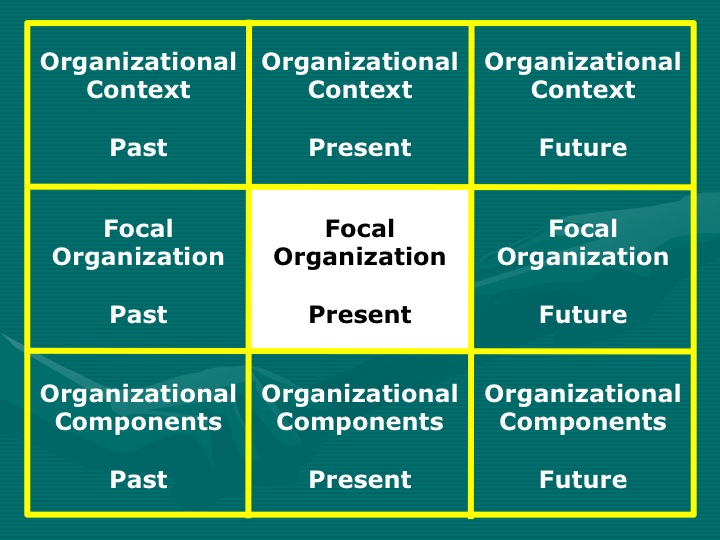
The three-level, nine-paned systems view
This perspective promotes the right questions about the dynamics at each of the three levels. At the product or component levels there are often fast-moving technological changes taking place. At the contextual level, political and institutional change becomes important. Clearly a manager is a person in the centre of a field of tension. This feeling was best conveyed by a single slide in the presentation. It shows the “steering wheel” of the enterprise that allows managers to navigate, using a well-known set of management “tools”:

The “Steering Wheel” of the Organization
The managers have to navigate between exploration on the one (left) hand and exploitation on the other (right) hand. Their ways of doing this can be grouped into four categories – according to this framework – power, management, leadership and culture. I didn’t have time to go into these in any detail, but I showed the steering wheel being turned left and right to keep the enterprise in a “sweet zone” between exploration and exploitation. To go “left” is to try something new and different and to court failure: to go “right” is to stick with the familiar and to risk falling into the crisis of a competency trap.
Supporting Evidence for This View
For the evidence to support this perspective of managers “in the middle”, alternating between the exploration for new opportunities and the exploitation of the most promising of them, I used MIT Sandy Pentland’s work. I have just reviewed his new book, Social Physics, and selected it as the best book of the year on innovation. In it he explains how he uses sociometers (smartphone-size instruments) to monitor multiple dimensions of body language (not content) on management teams. From a study of their interactions he can predict (with a surprisingly high level of confidence) which teams will do well on a variety of tasks. One of the things he looks for on creative teams is a “pulse” between exploration and exploitation and his measurements allow networks to “tune” themselves to the amount of these two activities they need.
In a broader context I think that measurements like Pentland’s, when used as feedback to allow teams and individuals to monitor and control their own interactions, point the way to liberating us from the tyranny of Key Performance Indicators (KPIs), the top-down management approaches that accompany them and the resultant crushing of innovation in large-scale organizations.
Posted in Change, General, Leadership | Tagged body language, ecological perspective, ecology of innovation, ecosystem, enterprise, exploitation, exploration, Innovation Congress, KPI, MIT, Sandy Pentland, Social Physics, steering, sweet zone, systems perspective, villach | Comments Off on The Ecology of InnovationCan Management Advance in This Way? A Question from the Global Drucker Forum 2014

Professor Clay Christensen: “Share each others’ slides.”
The 6th Global Drucker Forum ended on November 14 with a series of comments and calls to action from the major speakers involved. The last of these was HBS professor Clay Christensen, who called for more cooperation and harmonizing of language among management experts. He illustrated the kind of cooperation he was talking about with a story about Florida governor Jeb Bush and how he had shared slides from a presentation on the topic of child-centred education and the reform of the American education system. Forbes columnist Steve Denning quoted Christensen’s story in full and suggested that this is the way the management field should be headed.
I responded to his column and here is an expanded version of my comments:
“Perhaps Jeb Bush should have started closer to home with his brother, George W. who, with the No Child Left Behind legislation, embraced an evidence-based learning model. This required regular, standardized testing with teachers’ performance assessments based on the results. Many educationists see it as the antithesis of child-centered learning. The battle between the two continues to this day.
Posted in Change, General | Tagged Christensen, Drucker Forum, Frank Knight, Herbert Simon, Jeb Bush, management, philosophy, positivism, post-rational, Steve Denning, uncertainty | Comments Off on Can Management Advance in This Way? A Question from the Global Drucker Forum 2014Oppressive Bureaucracies Are a Symptom Not a Cause: Part I
This week I am off to Austria for two conferences. I am a keynote speaker at the Innovation Congress in Villach on November 13, where I will be talking about “The Ecology of Innovation” and I will then travel to Vienna to take part in the 6th Global Drucker Forum, where I am chairing a panel. I will be reporting on both meetings in future blogs.

Gary Hamel will be speaking at the 6th Drucker Forum
In the meantime the buildup to the Drucker Forum continues, with HBR blogs from several of the management gurus who are going to be present. Gary Hamel is one of those blogging; he published “The Core Incompetencies of the Organization” on October 31 and followed it up with the dramatically titled “Bureaucracy Must Die!” on November 4.
I replied to the first blog as follows:
“Your blog is descriptive of large organizations but does not explain how they got that way. All today’s large organizations started off small and earlier in their lives many of them were seen as pioneers of management practice. Standard Oil (ExxonMobil), US Steel, General Motors, Sears, Roebuck, Kodak, Xerox and Nokia (among others) were all held up as exemplary at one time or another. The “hero to zero” phenomenon is so pervasive in the corporate world that the explanations for it must go well beyond “hubris”, management “myopia” and “clueless” leadership. No doubt such conditions exist but, like oppressive bureaucracies, they may be symptoms rather than causes: unintended consequences of strategies pursued in contexts we don’t even acknowledge, let alone understand. The true causes must be complex mixes of the ecological and the evolutionary – a combination of the developmental dynamics whereby supple saplings become rigid trees and the evolutionary processes that allowed small mammals to replace large reptiles as the planet’s dominant species.
The virtual absence of these ecological and evolutionary concepts from the current management canon and the widespread use of structural and engineering analogies makes us insensitive to the roles of emergence and constraint in the lives of organizations. It leads to notions of managers as detached, rational strategists, scanning “the” environment, looking at their organizations objectively, implementing practices and applying “principles” by issuing crisp, actionable instructions. The firm itself is seen as a passive, command-and-control machine, waiting for orders to execute and strategies to implement. Thus mechanical analogies leave linear notions of cause-and-effect intact and they blame unintended consequences on inept managers, poor analysis and faulty implementation. It’s a self-sealing system, a hall of mirrors.
You are right that we need to go much deeper; much, much deeper. We need to assimilate the emerging evidence that humans are rational but in an ecological, rather than in a logical way. And that’s O.K. Our minds are embodied, not just “embrained”. “Thinking” is not just the conscious manipulation of abstract symbols: we can “think” about the world in just as many ways as we experience it. Immerse a collection of those kinds of minds in an ecological and evolutionary context, where causality is nonlinear, emergence matters and constraints are ubiquitous. Only then can one start to appreciate the complexity of the issues that we are dealing with, as well as the combinations of judgement and reason – wisdom – required to navigate them. It leaves one in something close to a state of awe for those practitioners who can.”
Bureaucracy Was a Discovery, Not an “Invention”
In his second blog, “Bureaucracy Must Die!” Hamel describes bureaucracy as an “invention”. If this is the case, he argues, all that is needed is for us to invent a benign substitute for it; “We must find a way to reap the blessings of bureaucracy – precision, consistency, and predictability – while at the same time killing it. Bureaucracy, both architecturally and ideologically, is incompatible with the demands of the 21st century.”

The Classic Bureaucracy – a Discovery, not an Invention
There is one problem: bureaucracy is not an invention; it is a discovery. It was made about ten thousand years ago when humankind started working with concentrated resources that required scale and specialization to exploit them. Prior to that they had lived in small, nomadic, hunter-gatherer bands that were ideally suited to exploring for and exploiting resources that were mobile and ephemeral. These bands of up to 150 people, divided in small, egalitarian groups, were in a constant state of motion. They were coordinated via a shared narrative, personal relationships, generalist skills and self-discipline. Their actions were determined by their shared understanding of the situation they faced. But when humans encountered concentrated resources like the flood-fed lands of the Nile Delta and the salmon-dependent ecosystems of the American North-West they had to cope with much larger numbers of people and the need for specialization. Store-houses needed to be built, with scribes to keep the count of what was in them and a security force to protect the resources from being stolen. Time became important as one had to be ready for the annual flood or the salmon run. Even very primitive technologies led to the emergence of functional silos and very different appreciations of situations that were difficult to share. Bureaucracy and hierarchy were needed to control these larger-scale organizations because they could no longer rely on face-to-face coordination in the way the hunter-gatherers had.
The Ecological/Systems Perspective
From an ecological/systems perspective, enabling bureaucracies and the hierarchies that accompanied them were (and still are) a solution to the problems of scale and specialization. They become oppressive and coercive when they were combined with an unhealthy lust for power over others on the part of those who rise to the top of organizations. When this happens, people in organizations change from being ends-in-themselves to becoming means to the purposes of others; they become tools and instruments. (Canadians will be very familiar with the recent case of the star radio-host Jian Ghomeshi, who seems to have had problems along these lines). As I explained in The New Ecology of Leadership:
“Large-scale organizations attract people with a need for power and success. Such individuals can deliver tremendous organizational performance because of their ability to articulate a vision, rally followers around them, and challenge the rules about how things are done. Unfortunately, large organizations sometimes appeal to high-functioning but unhealthy, narcissistic individuals with excessive needs for attention and recognition.When success confirms and reinforces these behaviors, they can become overblown.
In their extreme manifestations such behaviors can take the pathological form of the so-called dramatic, emotional, and erratic personality disorders.A vision coupled with success can lead to grandiosity and illusions of invincibility. Poor listening skills and a fundamental lack of empathy can result in a thin-skinned, hypersensitivity to criticism and the encouragement of followers to become submissive yes-people. A history of rule breaking without negative sanctions can create beliefs that such restrictions do not apply to them. The very real sacrifices that such managers make as they climb the career ladder and pursue power can lead to a powerful sense of entitlement once they achieve it.
This means that over time the productive hierarchy essential to running the repetitive operations of a large-scale, commercial organization can start to take on the trappings of a dominance hierarchy, whose priority is not to create wealth but to distribute it—among its own members.”
In short, the pathologies of bureaucracy have to be understood as the product of an interaction between humans, with their ecologically rational, embodied minds and an organizational form that has been around for only 10,000 years or so, which is not very long in evolutionary terms. We cannot discard bureaucracy; we have to understand its dynamics and its limitations and how to use it in combination with “hunting dynamics” of the hunter-gatherers. Only then can we get more of its benefits and less of its liabilities. That will be the subject of a future blog.
Posted in Change, General | Tagged bureaucracy, change, clueless leadership, community, Drucker Forum, ecological perspective, ecological rationality, embodied mind, Gary Hammel, GPDF14, hubris, hunter-gatherer, hunting dynamics, Innovation Congress, Jian Ghomeshi, myopia, The New Ecology of Leadership | Comments Off on Oppressive Bureaucracies Are a Symptom Not a Cause: Part IThe Great Transformation: a Historical Perspective

The Great Transformation Vienna November 13-14
The sixth annual Drucker Forum takes place in Vienna from November 13 to 14. The theme is the “The Great Transformation: Managing Our Way to Prosperity” and the forum features a pantheon of the ABCs (academics, business people, and consultants) of management. It showcases some of the leading management thinkers from around the world including Harvard’s Clayton Christensen and gurus Gary Hamel, Rita McGrath and Roger Martin. Top journalists are going to be there in the form of Andrew Hill and Martin Wolf of the Financial Times, Adrian Wooldridge of the Economist and Adi Ignatius, editor of the Harvard Business Review. For me the most exciting thing about the meeting is that it attracts people with a very wide range of ideas, interests and experiences. Almost everyone is there for the duration and you get to interact with them all in numerous informal sessions and breaks.
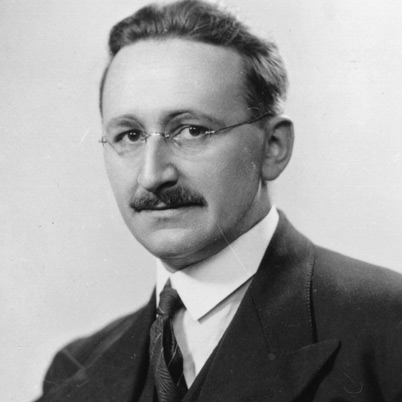
Friedrich Hayek (1899-1992)
One of the most interesting background aspects of this meeting, with its provocative theme, is that 2014 is the 70th anniversary of the publication of two key books by Austrian writers that have greatly influenced management and political thinking. The first is Friedrich Hayek’s Road to Serfdom and the second is Karl Polanyi’s The Great Transformation. Hayek’s book warned of the tyrannical perils of central planning. In his adopted country of Britain it was aimed at the many left-wing British academics, who saw fascism as a capitalist reaction against socialism. Hayek argued that fascism and communism were both totalitarian philosophies with their roots in central planning and state control. Hayek saw important roles for the state, however, and was opposed to laissez-faire capitalism. In the United States, on the other hand, Road to Serfdom, was picked up by the right wing, and championed by prominent economists like Milton Friedman. In the Cold War atmosphere it was often interpreted as a paean to free markets and a condemnation of government intervention. In short, it was (and often still is) an “either/or” interpretation – markets “ennoble” society – they turn private vice into public virtue, everywhere and always. Continue reading →
Posted in Change, General | Tagged Adrian Wooldridge, Andrew Hill, Clayton Christensen, Conservative, Drucker Forum, Ecological Vision, Gary Hamel, Gemeinschaft, Gesellschaft, Great Transformation, liberal, Martin Wolf, Milton Friedman, Peter Drucker, Rita McGrath, Roger Martin, The Fatal Conceit, Walter Bagehot | Comments Off on The Great Transformation: a Historical PerspectiveTo Kill a Zombie: Ending Shareholder Primacy
 The theme of the Drucker Forum to be held in Vienna November 13-14 this year is “The Great Transformation: Managing Our Way to Prosperity”. In the run-up to it Simon Caulkin wrote a mainly excellent article in the Financial Times entitled “Era of management-led growth held hostage by old ideas that refuse to die”. In it he outlined the challenge of changing the assumption that the purpose of the corporation is to maximize returns to shareholders. He cited Lynn Stout’s work, among others, to assert that “shareholders own shares, not companies, which are separate legal persons, and directors’ only fiduciary responsibility is to the company. Shareholders are not principals and managers are not their agents.” Caulkin described the whole shareholder-primacy theory as a zombie idea.
Then he went off the rails a little by mixing his monster metaphors: “So, yes, an era if management-led growth is both feasible and urgently needed. But the renaissance will not flourish unless a stake is driven through the heart of the shareholder-primacy zombie first.”

This won’t work with zombies!
Every monster hunter knows that you can kill only vampires by driving stakes through their hearts; to kill a zombie you have to disintegrate their brains. The shareholder-value model may suck out the lifeblood of corporations but it doesn’t have a heart. Its brain is in thrall to neoclassical economics with its belief in the sanctity of free markets and its scientistic assumption that if humans aren’t completely rational then they ought to be. Unfortunately the shareholder-value model is held in place by a powerful systems dynamic that works like an addiction. The short-term rewards for those who benefit – corporate executives, hedge funds, and buyout artists – are significant, while the long-term damage is only now becoming visible. Even then, the complexity of cause-and-effect in complex systems allows many to deny that any such relationship exists. As Upton Sinclair’s quip reminds us: “It is difficult to get a man to understand something, when his salary depends on his not understanding it.”
So how to disintegrate this zombie idea’s brain? I have suggested a change in metaphor might help, from that of monsters to systemic addiction. Most addictions end only when the addict “hits the wall” and makes a radical attempt to change his or her lifestyle and avoid the contexts that trigger the habit. Often this takes a shattering event – either a personal crisis or an encounter with a charismatic individual, or perhaps both. I suspect that it will require similar events in the case of shareholder-primacy model – a crisis plus the emergence of charismatic enterprises that show a consistent ability to outperform their conventional counterparts in sustainability and service to their communities, while operating at a scale comparable to their conventional counterparts. Oh, and it couldn’t hurt to attack the idea intellectually, as Lynn Stout has done, and try to disintegrate its brain…
Posted in Change, General | Tagged addiction dynamic, Anglo-Saxon capitalism, change, complex systems, crisis, Drucker Forum, Financial Times, Global Drucker Forum, Lynn Stout, shareholder value, Simon Caulkin, The Great Transformation, Upton Sinclair, vampire, zombie | Comments Off on To Kill a Zombie: Ending Shareholder PrimacyWhat They Should Be Teaching at Business Schools

Robert Reich, Former Secretary of Labor
Robert Reich, former Secretary of Labor under Bill Clinton had a recent blog in the Harvard Business Review entitled “How Business Schools Can Help Reduce Inequality”
Here is my response:
“What is needed is an ecological framework of “both…and” to embrace and contain the “either/or” of economics. Only then will we be able to see effective management practice as the integration of the “hard” and the “soft”, the sciences and the humanities. The most encouraging indicator of this at HBS has been the appointment of Nitin Nohria as dean, with his academic interest in the power of context and contextual intelligence. An article on this topic by Tarun Khanna appeared in a recent issue of HBR.
An ecological perspective is the quintessential contextual view. From this vantage point we can see that enterprises are conceived in passion, born in communities of trust, grow through the application of reason and mature in power, where they tend to get stuck. This sets them up for crisis and destruction but with the possibility of renewal. At business schools an ecological perspective can be used to address complex existential questions like these:
- What kind of person am I (people are we)?
- What kind of situation is this?
- What does a person like me (a people like us) do in a situation like this?
- What are my/our options? How do I/we generate options?
- What are my/our decision criteria? how do I/we make decisions/choices?
- What are the consequences of my/our decisions/choices?”
In a subsequent posting Judith Samuelson refers to a helpful document from the Aspen Institute on the subject of corporate purpose and business education
Posted in General | Tagged Aspen Institute, business education, business schools, complexity, corporate purpose, ecological perspective, existential questions, Harvard Business Review, Judith Samuelson, Nitin Nohria, Tarun Khanna | Comments Off on What They Should Be Teaching at Business Schools ← Older posts Newer posts →Subscribe to David's Blog
-
Archives
- July 2026
- May 2026
- October 2025
- January 2025
- November 2024
- May 2024
- February 2023
- December 2022
- September 2022
- May 2022
- March 2022
- February 2022
- November 2021
- October 2021
- January 2021
- November 2020
- September 2020
- July 2020
- June 2020
- May 2020
- April 2020
- February 2020
- January 2020
- September 2019
- July 2019
- April 2019
- March 2019
- November 2018
- October 2018
- March 2018
- July 2017
- April 2017
- November 2016
- October 2016
- June 2016
- May 2016
- April 2016
- March 2016
- December 2015
- November 2015
- October 2015
- May 2015
- March 2015
- January 2015
- December 2014
- November 2014
- September 2014
- July 2014
- June 2014
- May 2014
- April 2014
- March 2014
- February 2014
- January 2014
- December 2013
- November 2013
- October 2013
- September 2013
- August 2013
- July 2013
- June 2013
- May 2013
- April 2013
- March 2013
- February 2013
- January 2013
- December 2012
- November 2012
- October 2012
- September 2012
- August 2012
- July 2012
- June 2012
- May 2012
- April 2012
- March 2012
- February 2012
-
Meta

David Hurst in Action

Consulting